Work./Incentivized Reviews
UX Strategy
Loyalty
UX Research
Cross Functional

Getting customers to share what they actually think.

Review volume was lower than expected across the catalog. We introduced loyalty points as an incentive, facilitated cross-functional alignment, and launched a controlled v1 that tripled daily review volume.

WHY THIS MATTERED TO THE BUSINESS
Merchants needed faster, more consistent insights. The goal was to reduce analysis time while improving confidence in the decisions made across a large catalog.
COMPANY
American Eagle Outfitters
ROLE
UX Strategist
300%
Review Volume Increase
Averaging 1,500 reviews per day
50 pts
Per Approved Review
Awarded through existing loyalty program
Measurable
Loyalty Sign-ups
Small but real increase in new loyalty accounts
Cover image
American Eagle Outfitters
UX Strategist
Overview

More reviews without making them meaningless.

Review volume was lower than expected across PDPs. Marketing and UX partnered to explore whether loyalty points could increase participation without turning the reviews section into a points farm.

The challenge wasn't technically complex. It was strategically complex. How do you incentivize behavior without distorting it? That question shaped every decision from scope to launch.

Business context
Reviews influence purchase decisions, return rates, and merchandising strategy. Low catalog coverage meant customers had less confidence buying and the business had less signal to work with. Both problems had the same fix.

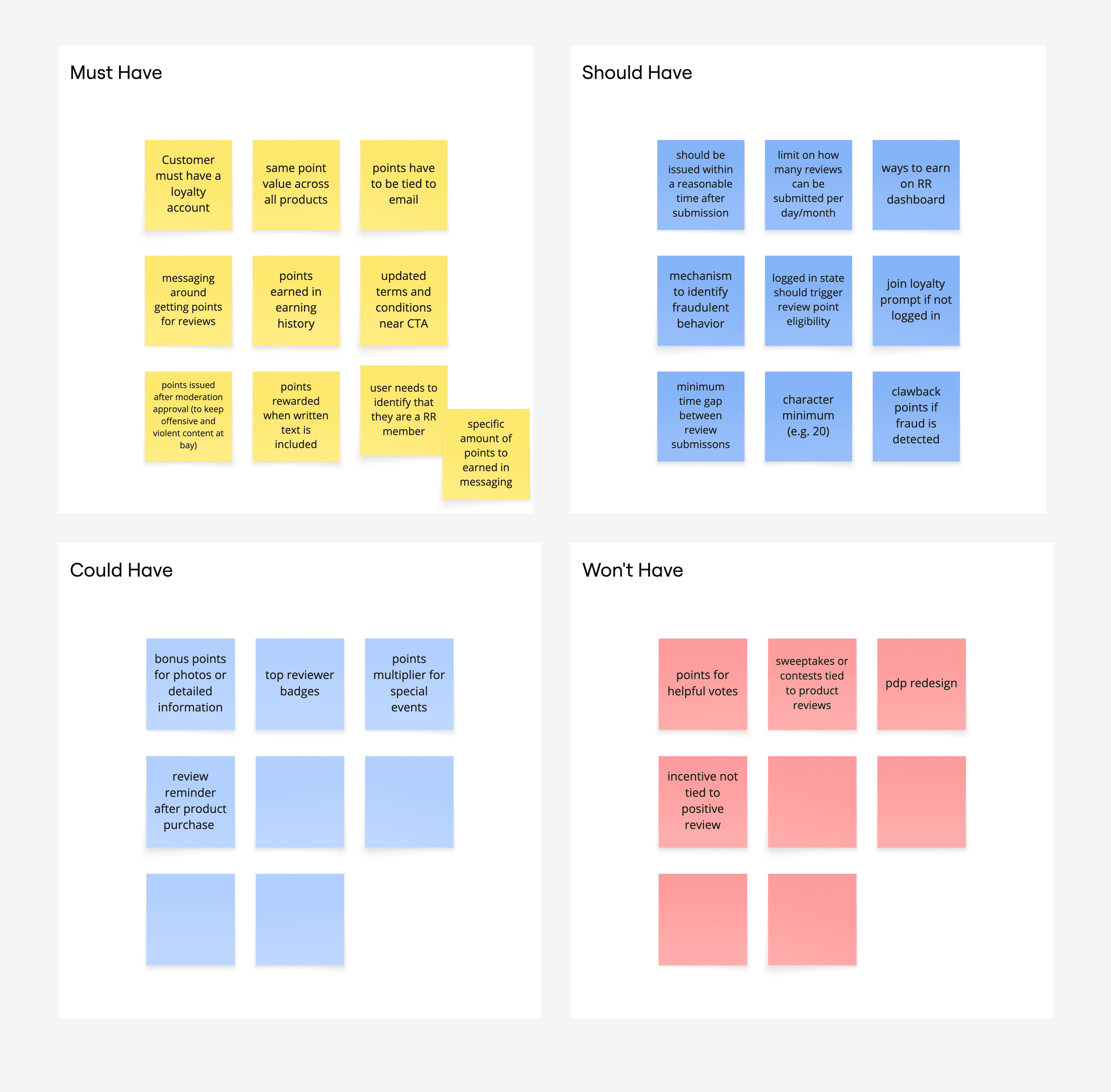
I partnered with another strategist to run a cross-functional workshop using MoSCoW prioritization, bringing marketing, engineering, legal, product, and UX into the same room before anyone wrote a spec.

My contributions

Led UX strategy and competitive research
Facilitated cross-functional alignment workshop
Defined Phase 1 MVP with documented tradeoffs
Partnered with product and engineering on loyalty platform constraints

Strategic context

Part of a broader effort to expand non-transactional loyalty earn
Required alignment with legal on incentivized review disclosure
Used Crowdtwist loyalty platform with limited customization options
Problem & Solution

Incentivize participation without paying for sentiment

The core tension was real: introduce an incentive strong enough to change behavior, but not so transactional that it undermined the authenticity customers rely on when reading reviews.

The problem

Review volume too low to be useful

PDPs lacked review coverage. Merchandising teams had limited qualitative signal. Customers had less confidence buying without peer input. And the business had no low-friction way to change that.

The solution

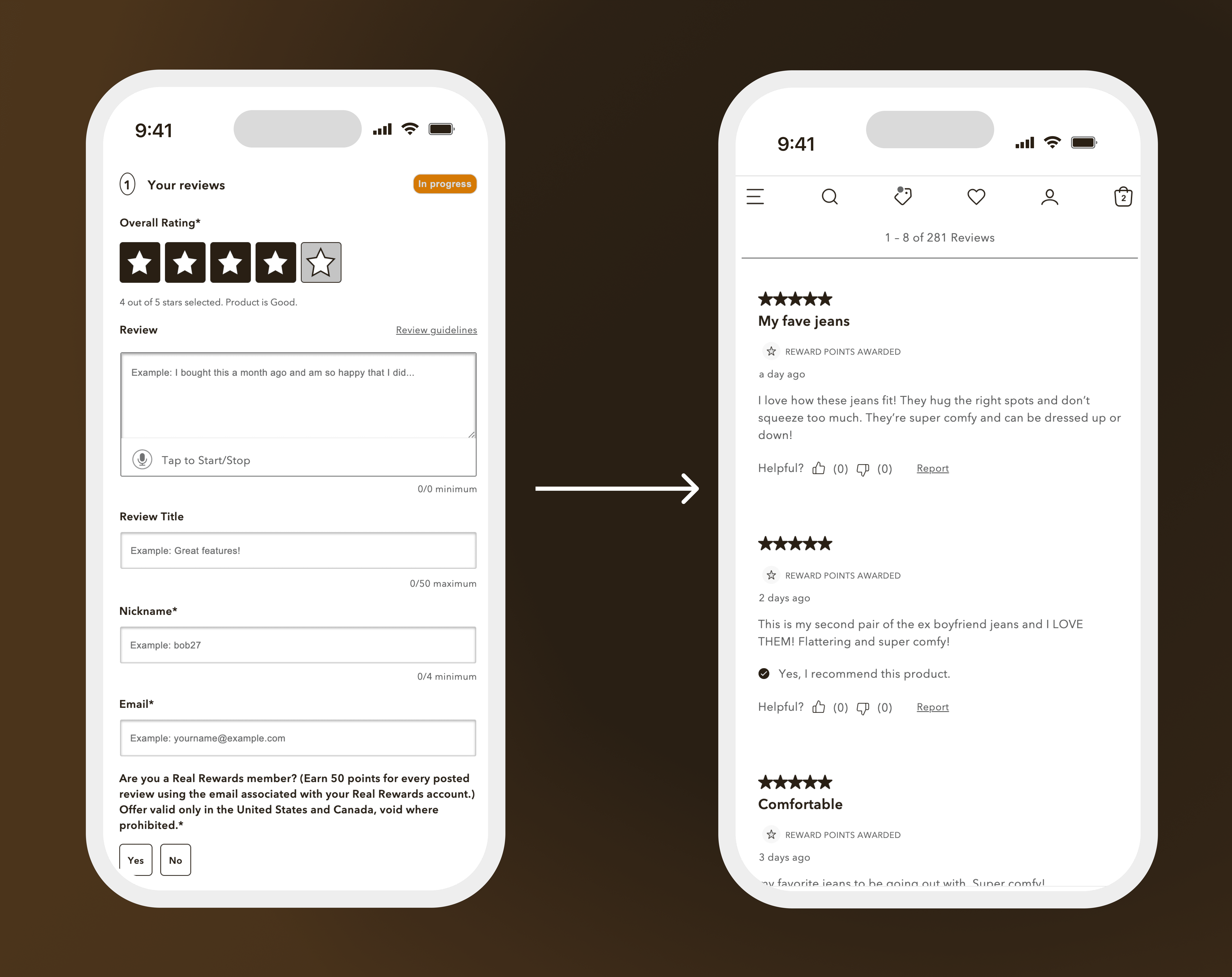
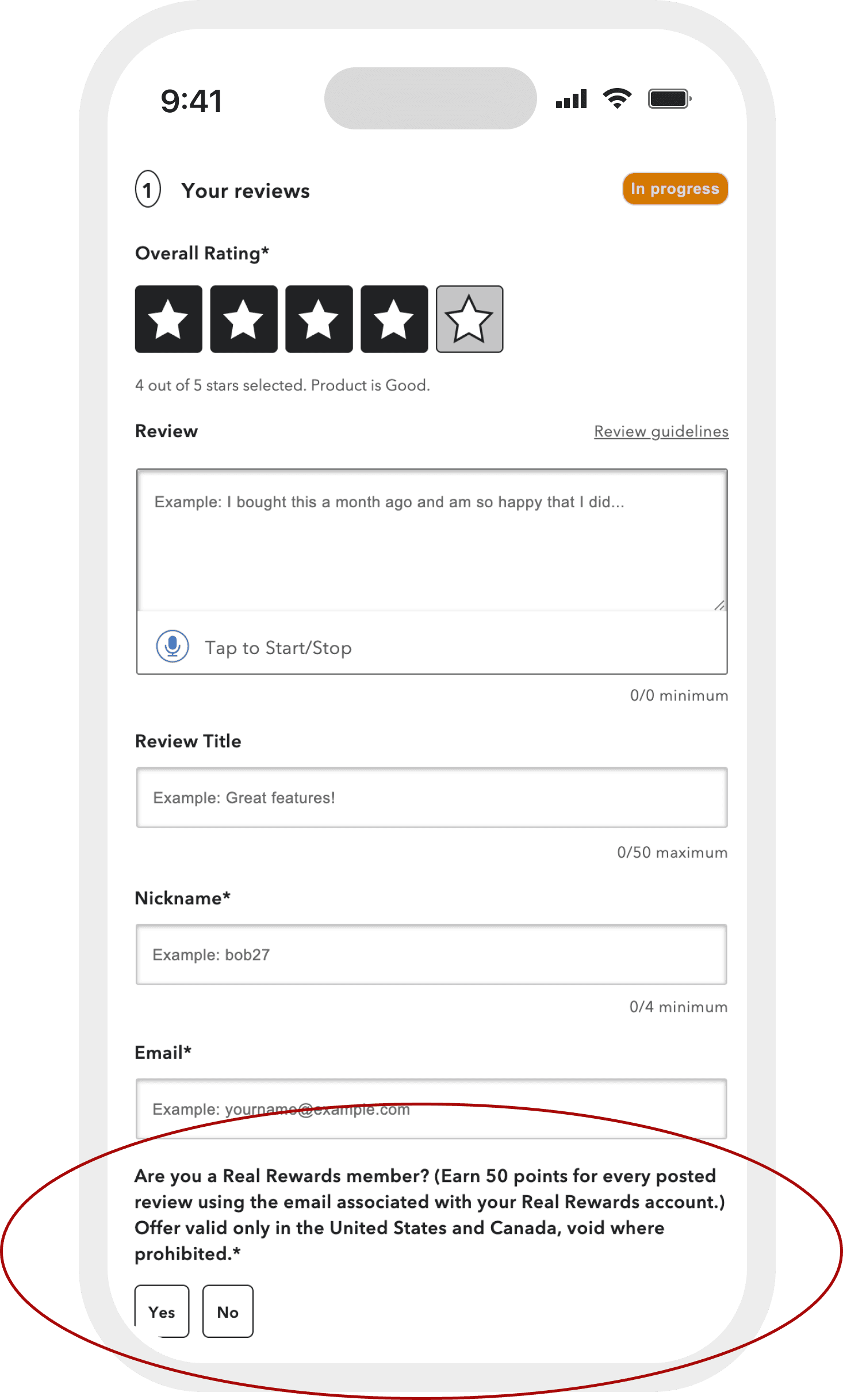
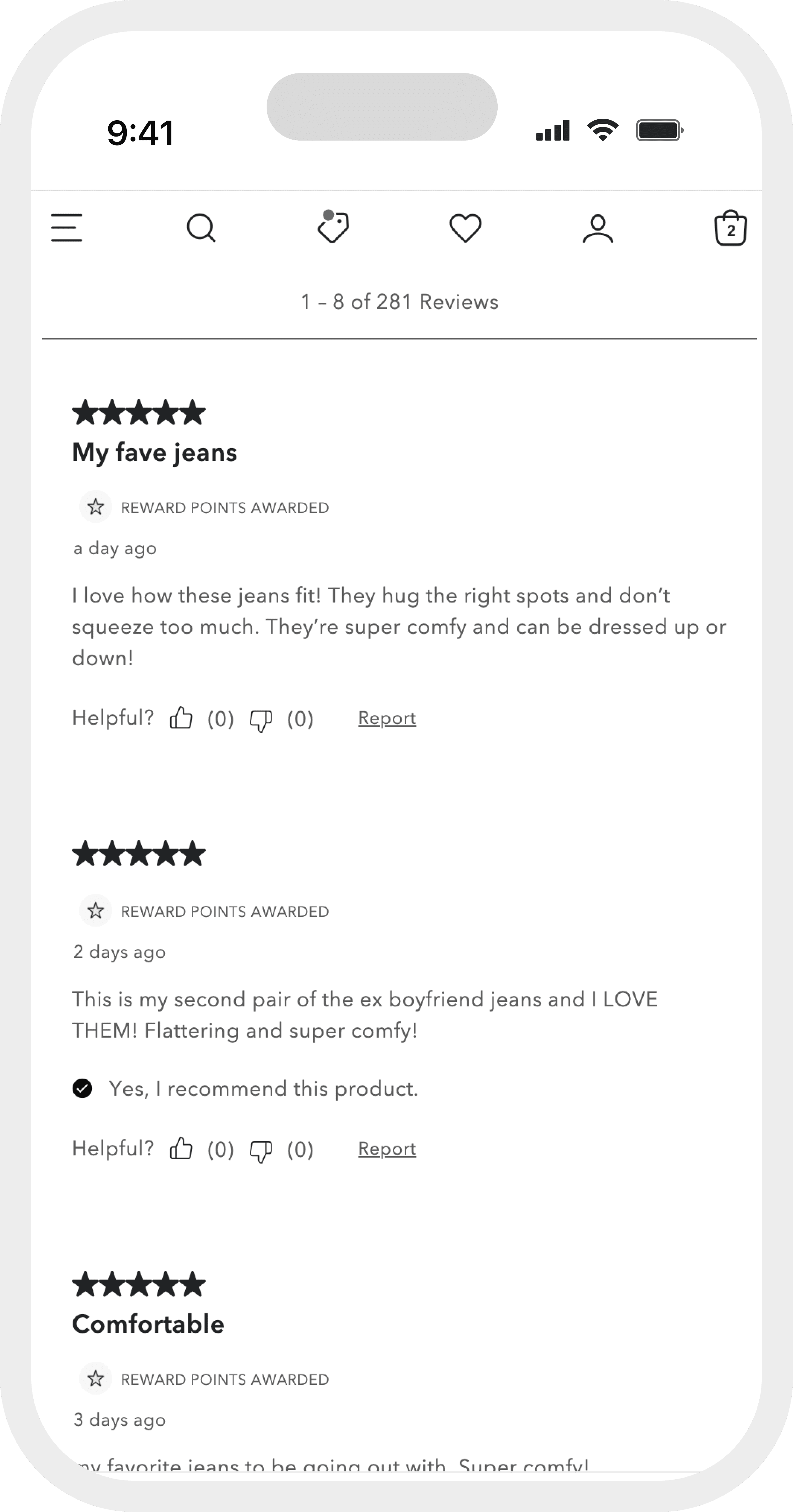
50 loyalty points per approved review, integrated into existing flows

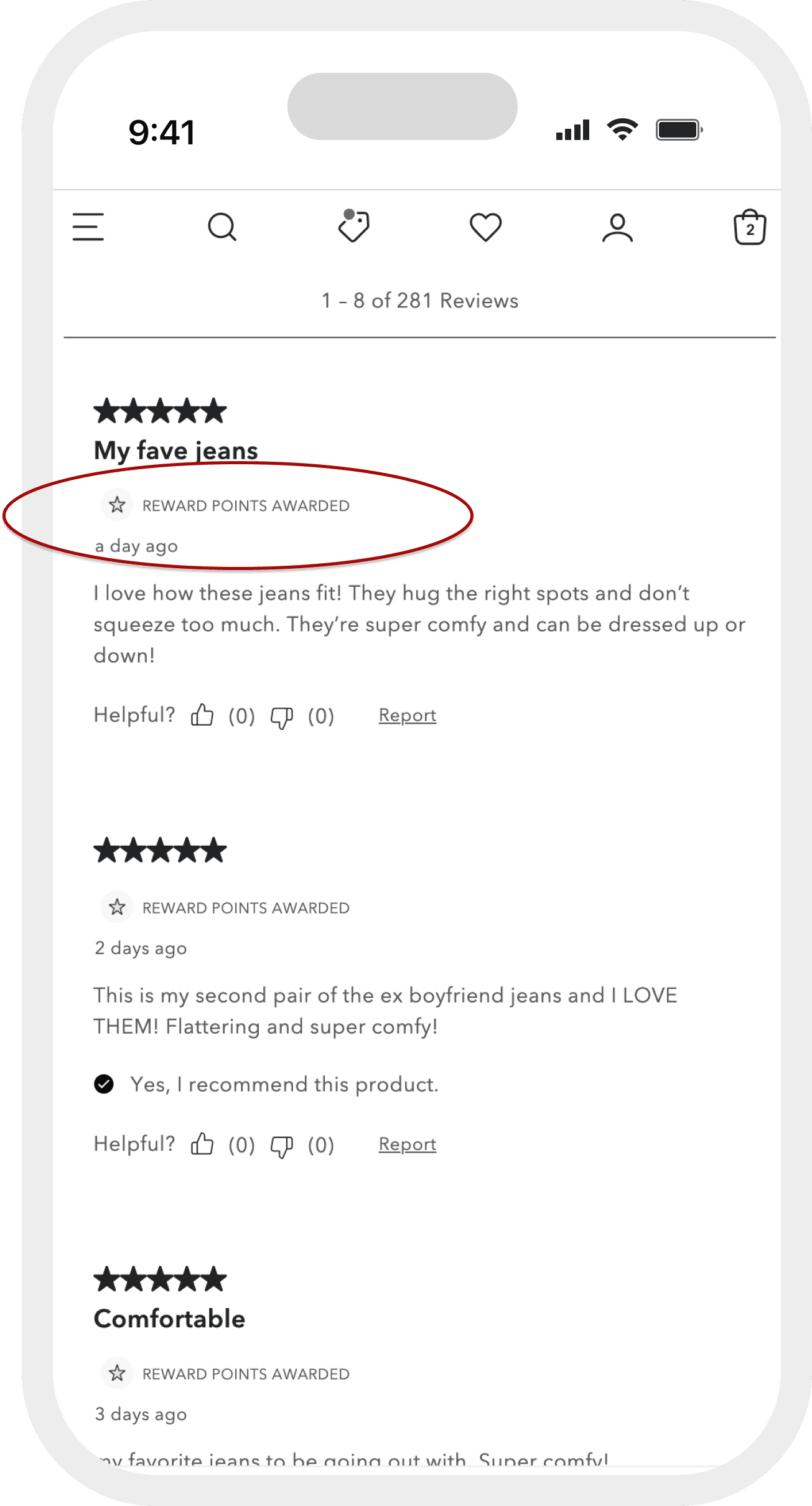
Awarded 50 loyalty points per approved review through the existing program. Integrated the earn into current review flows. Matched reviews to loyalty accounts via submitted email. Positioned points as appreciation, not payment.

Key tradeoffs I made
Choose This
Accepted low-quality review risk in v1
No character minimum was a known risk. The decision was intentional: learn from real behavior before over-engineering controls that might not be necessary.
Choose This
Email matching over required sign-in
The platform couldn't require sign-in before reviewing. Email matching was a workable proxy that kept friction low and still connected most reviews to loyalty accounts.
Pushed Back
Held scope to Phase 1 MVP
Cross-functional complexity created pressure to solve everything upfront. The workshop helped the team agree on what to defer and why, rather than expanding scope to handle every edge case before launch.
Final design

Research

Customers weren't disengaged. They just needed a reason.

I analyzed how other retailers incentivize reviews, focusing on whether incentives were transactional or loyalty-based, how they were communicated, and what guardrails were in place to protect quality.

The competitive finding was consistent: incentives increase participation, but guardrails and expectations heavily influence quality. Most retailers launched lean and iterated once they understood real behavior.

Motivated to help

Primary motivation

Customers leave reviews to help others or express strong feelings, not primarily for rewards

Framing matters

Incentive positioning

Incentives framed as appreciation drove better participation than those framed as payment

Launch lean

Competitor pattern

Launch with minimal controls, learn from real behavior, then tighten guardrails in later phases

"Incentives increase participation, but guardrails and expectations heavily influence review quality."

This shaped the Phase 1 strategy: launch with enough structure to be credible, accept known risks intentionally, and use real behavior to inform what to tighten in future phases.

Outcomes

Triple the reviews, real tradeoffs, useful learnings

The results validated incentives as an effective lever while surfacing clear opportunities for refinement. The anticipated quality tradeoff materialized exactly as expected, and the team had a real foundation for Phase 2.

300%
Review Volume Increase

From baseline to approximately 1,500 reviews per day

Both
Quality Distribution

Increase in both high-quality and low-quality reviews, anticipated and accepted as a Phase 1 learning

Measurable
Loyalty Sign-ups

Small but real increase in new loyalty account creation tied to the review flow

Beyond the metrics

The workshop model here, MoSCoW prioritization with legal, marketing, engineering, and design in the same room, became a reference for how to run cross-functional alignment on ambiguous initiatives. That process had longer legs than the feature itself.

What I'd do differently

Introduced a soft character minimum earlier. Even 20 words would have filtered the lowest-effort submissions without meaningfully reducing participation.

Tracked the ratio of high-quality to low-quality reviews as a health metric from day one, not just total volume.

What I'm proud of

Running a workshop that produced actual decisions. Cross-functional alignment sessions often end in notes. This one ended in a scoped MVP everyone had signed off on.

Framing the known risks openly rather than minimizing them. The team launched informed, not optimistic.

Building strong cross-functional relationships

Next project

Store Purchase History

View case study →Back to all work
Shana Shields
SENIOR PRODUCT DESIGNER (UX & STRATEGY)
© 2026 S. Shields · All rights reserved
Shana Shields
SENIOR PRODUCT DESIGNER (UX & STRATEGY)
© 2026 S. Shields · All rights reserved

Create a free website with Framer, the website builder loved by startups, designers and agencies.